
CIS gross payment status is the 0% rate: instead of a contractor taking 20% or 30% off your labour and sending it to HMRC, you are paid in full and settle your own tax later. If you have ever wondered why some subcontractors get their invoices paid without a CIS line on them at all, this is how, and this guide covers what gross payment status means, whether you are likely to qualify, and how to apply.
It is not a discount or a loophole. It is simply a different way of paying the same tax, on your own schedule instead of a contractor's. For an established, well organised business it can be a genuinely useful change. For others it can create a problem it was never meant to solve. Worth understanding both sides before you apply.
What is CIS gross payment status?
Under the Construction Industry Scheme, a contractor normally deducts either 20% or 30% from the labour element of what they pay you, and sends that money to HMRC as an advance payment towards your tax. Gross payment status changes that: HMRC lets you be paid the full amount, with nothing withheld, and you account for the tax yourself later through your Self Assessment return if you are a sole trader or partner, or through Corporation Tax if you run a limited company.
It sits alongside the standard 20% and 30% rates as the third CIS deduction rate, just at 0%. Our guide to how CIS works for subcontractors covers all three rates and where gross status fits among them if you want the fuller picture first.
Nothing about your tax bill changes. You still owe the same Income Tax, National Insurance or Corporation Tax on your profits either way. What changes is the timing, and who is holding the money in the meantime.
Why gross payment status matters for cash flow
This is the entire point of applying. Under the standard rate, 20% of every labour payment goes straight to HMRC and sits there until you reclaim it through your tax return, sometimes many months later. On a subcontractor turning over a decent sum a year, that is a meaningful amount of your own working capital parked with HMRC rather than in your bank account.
With gross payment status, that same 20% stays with you the moment you are paid. You can use it to buy materials, cover wages, fund plant hire, or simply smooth out the gaps between jobs, rather than waiting for a refund. Run your own numbers through the free CIS deduction calculator to see exactly how much of your labour income is currently being held back under your existing rate.
The trade-off is that the discipline of saving for your tax bill moves entirely onto you. More on that later.
The three HMRC tests you must pass
Gross payment status is not automatic and it is not guaranteed to last. HMRC assesses every applicant against three separate tests, and you need to pass all three. The full detail and current thresholds are set out in HMRC's gross payment status guidance, but here is what each test is actually checking.
1. The business test
HMRC wants to see that you are running a genuine construction business in the UK, not just doing occasional work. That usually means the business is run through a UK bank account, and that construction work is a real, ongoing part of what you do rather than a one off.
2. The turnover test
Your construction turnover, excluding VAT and the cost of materials, has to clear a minimum threshold over the last 12 months. At the time of writing, that threshold is £30,000 for a sole trader, and £30,000 for each partner in a partnership or each director or relevant person in a limited company. Where a business has several partners or directors, there is also a multiple relevant persons alternative: instead of every single person clearing £30,000, the business as a whole can qualify by clearing £100,000 in total turnover. These figures do change from time to time, so always check the current amounts on GOV.UK before you apply or rely on them.
This is the test that quietly rules gross payment status out for a lot of smaller or newer subcontractors. If your turnover is well under the threshold, it is worth waiting until the business has grown into it rather than applying prematurely.
3. The compliance test
HMRC looks at your tax history over the previous 12 months: whether Self Assessment or Corporation Tax returns were filed on time, whether CIS returns were submitted correctly if you also engage subcontractors yourself, and whether tax, National Insurance and CIS payments were made when they were due. HMRC allows a small number of minor or late payments within set limits, so one slip does not automatically disqualify you, but a pattern of missed deadlines will.
The turnover test decides whether you can apply. The compliance test decides whether HMRC believes you when you do.

How to apply for gross payment status
You have to be registered for CIS as a subcontractor before you can apply for gross payment status. If that step is not done yet, our guide to how to register for CIS covers it, and it only takes a few minutes.
Once you are registered, you can apply for gross payment status either at the same time as registering, or later once your business has grown into the turnover threshold. The application is made online through your Government Gateway account, using HMRC's CIS registration service. Sole traders, partnerships and limited companies all apply through the same online route, though a limited company needs to register the company itself, not just the individual directors.
Be ready to show your turnover figures and evidence that the business is genuinely trading in construction. HMRC's decision typically takes a few weeks, and if you are approved, your gross status applies going forward, so it will not affect payments already made under the 20% or 30% rate. Until it comes through, keep invoicing as normal. Our guide on how to send a CIS invoice covers exactly how to lay out labour, materials and any deduction correctly in the meantime.
How HMRC reviews it, and how you can lose it
Gross payment status is not a one off approval you get and forget. HMRC reviews it annually, checking your compliance record and turnover against the same tests you passed to get it. It can also review your status at any point if something changes, such as a late payment, a missed return, or a sharp drop in turnover.
If you fail a review, HMRC can cancel your gross payment status and move you back onto the 20% or standard rate. There is usually a required waiting period before you can reapply, so a lapse is not something to shrug off. The most common reason subcontractors lose it is simply late payment of tax or National Insurance once the automatic 20% deduction is no longer there to force the saving habit.
Keeping your returns filed on time and your payments up to date is the whole game here. If you are ever unsure where you stand, checking your HMRC record before it becomes a problem is far better than finding out at review time.
Is gross payment status worth it?
For an established subcontractor or small firm with steady turnover and a solid handle on its own bookkeeping, gross payment status is usually a clear win. Keeping the 20% at the point of payment rather than waiting to reclaim it frees up real working capital, and it also means one less thing for a contractor to get wrong on your payments.
It suits businesses less well when the discipline is not there to put money aside for the eventual tax bill. Without a contractor automatically holding back 20%, that saving has to happen yourself, and the subcontractors who come unstuck with gross status are usually the ones who spent it as it came in rather than setting a portion aside for Self Assessment or Corporation Tax. If that discipline feels shaky, it may be worth staying on the 20% rate a little longer: it does the saving for you, and reclaiming any overpayment at year end is straightforward.
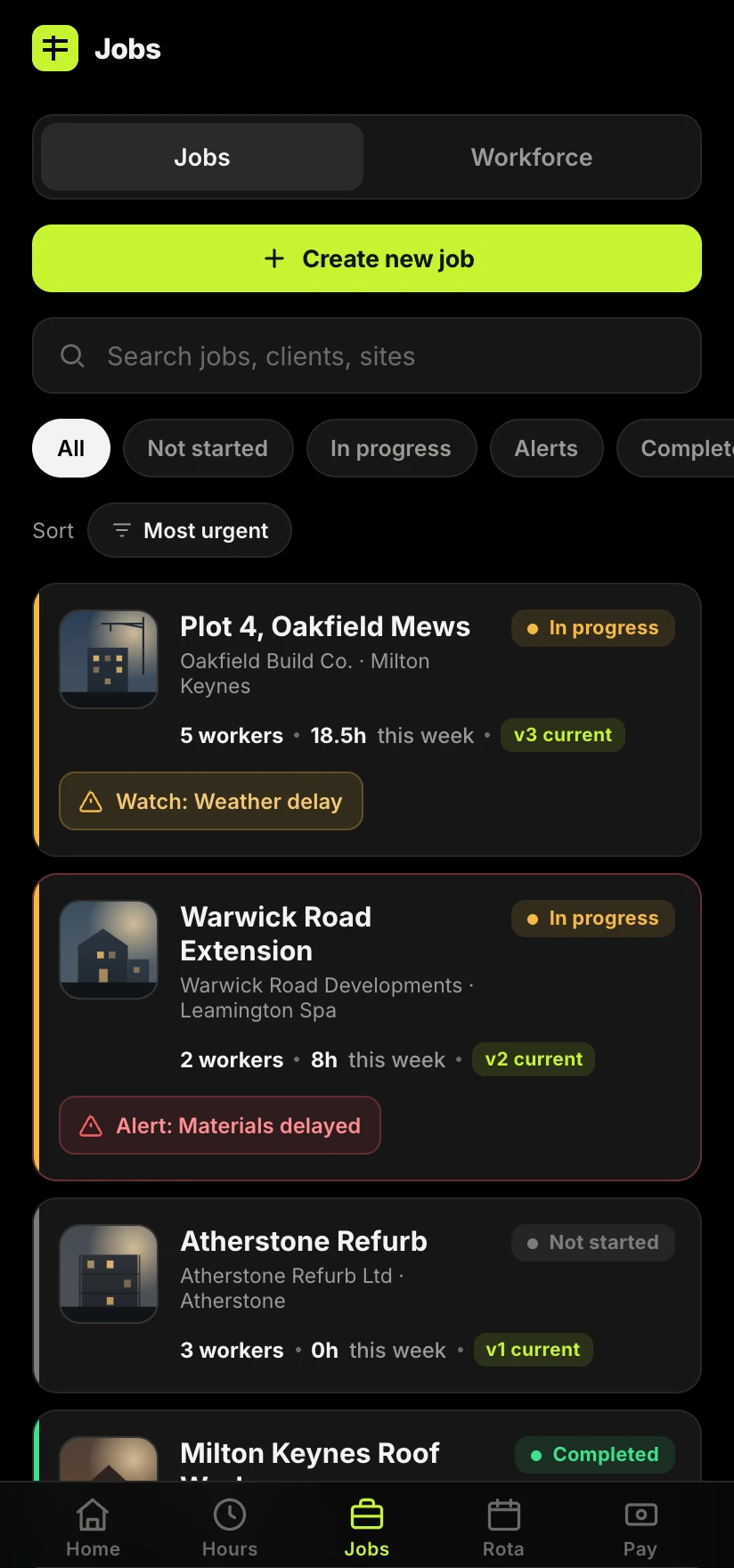
Whichever rate you are on, the businesses that manage CIS well are the ones with clean, current records: turnover figures to hand, returns filed on time, and every invoice and payment kept against the job it came from. That is exactly the habit HMRC's compliance test is designed to reward, and it is exactly what Sitewise is built to make effortless: hours, invoices, CIS statements and payments all filed against the job automatically, so your compliance record stays clean without extra admin. Our subcontractor hub has more on how it fits together. For the background on CIS generally, HMRC's CIS overview is the definitive starting point.
Take the admin off your hands.
Sitewise keeps every hour, invoice and payment record filed against the job it belongs to, so your books are always in the tidy, up to date state HMRC's compliance test is looking for.
Join the Sitewise waitlistFree to join. Be first in when early access opens.
Frequently asked questions